Analyses
The figures below are labelled in Hungarian.
Nomenklatura as a system of cadre lists: a distinctive feature of communist political rule

The system of cadre lists, the so-called nomenklatura, was an especially important instrument of communist political and economic rule. It enabled the party-state to block any change coming from below immediately. A necessary precondition was, of course, that no one could be independent of the state. Nationalisation was indispensable not only for the so-called planned economy but also for maintaining the political dictatorship, because economic independence, converted into political capital, could have threatened the party’s claim to sole rule.
The essence of the system was that organisational positions were assigned to the different levels and offices of the party-state, and the filling of these positions could be decided at the given level of the party. At the top of the nomenklatura system stood the actual leaders of the party-state, its general secretaries.
 | 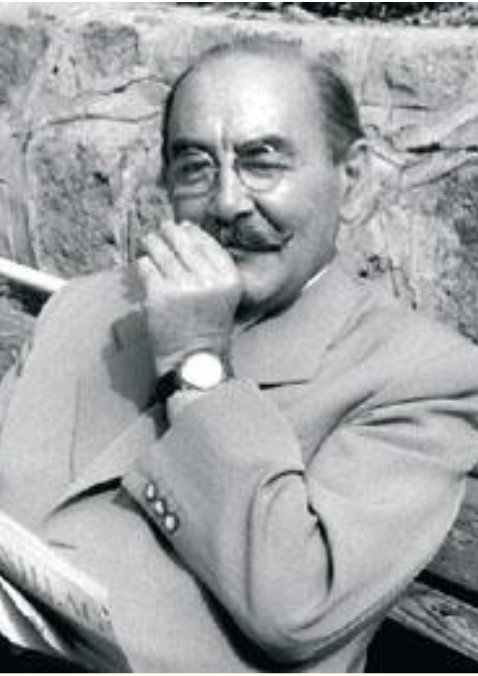 | 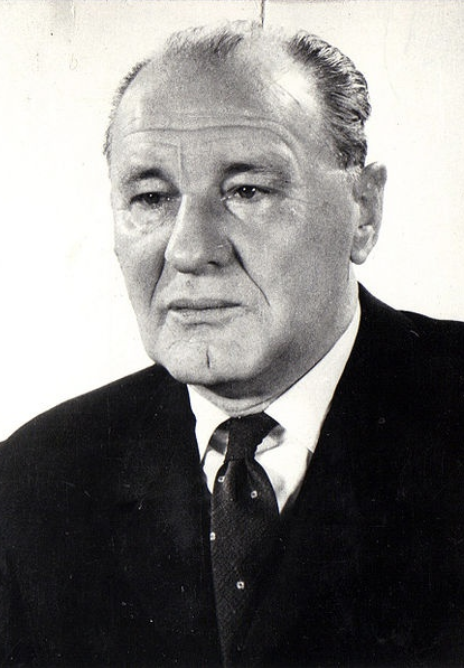 | 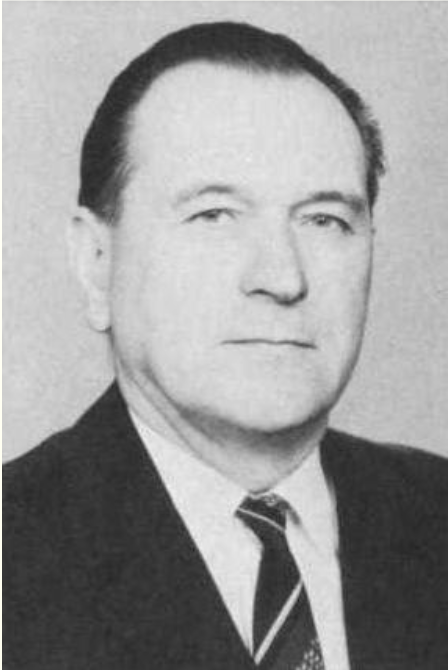 | 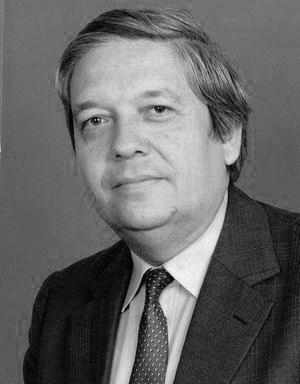 |
| Mátyás Rákosi | Imre Nagy | János Kádár | Károly Grósz | Imre Pozsgay |
Formally, the top leaders never held more powers than the other party leaders, but in practice they were always able to appropriate the highest decision-making powers on personnel matters.
Every two or three years a party resolution was adopted on the cadre system, reshaping the system of appointments. Let us look at short excerpts from two such resolutions.
“Cadre authority extends to the following main personnel matters:
- appointment (election), promotion, transfer, release, removal, recall, placement in a lower post;
- evaluation;
- government decorations;
- sending to higher-level political and state schools;
- longer official trips abroad;
- authorising the initiation of disciplinary proceedings.”
the nomenklatura list of the Central Committee, 18 October 1977
“The Central Committee
a) elects from among its own members, under the Organisational Rules...
b) appoints...
c) takes a position, before their election or appointment, on those proposed for the following offices...”
the nomenklatura list of the Central Committee and its organs, 23 January 1968
As its name suggests, the cadre system gave party functionaries in the various party offices the right to appoint and remove. To understand the nomenklatura system, one must first know how the party-state itself was built, and in what hierarchical order the appointers were arranged. The following figure shows the organisational hierarchy of the party.
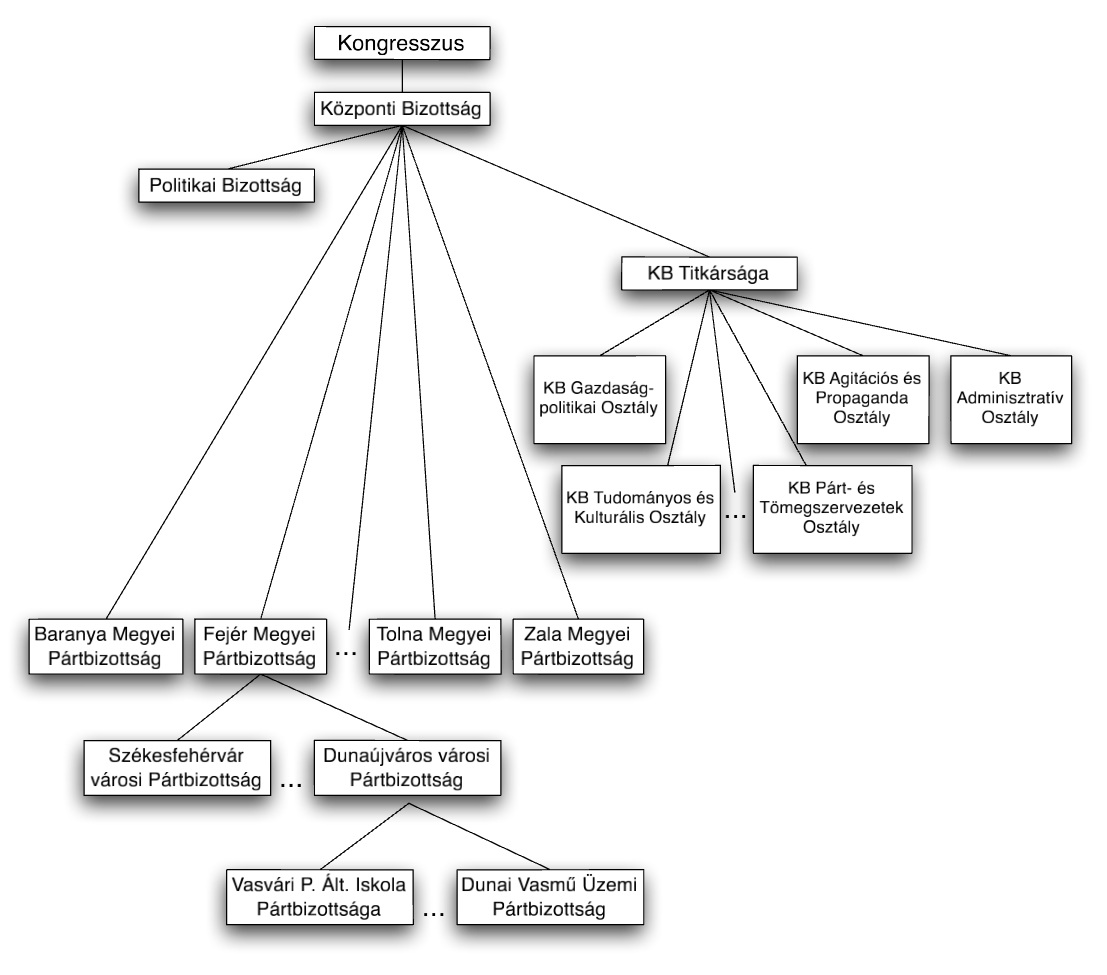
the organisational hierarchy of the Communist Party
Several factors must be taken into account to understand the real decision-making weight and power of the party organs shown in the figure. The real strength of a political body is significantly influenced (and often determined) by
- how often it meets,
- how many members it has, and
- whether it has an apparatus to prepare its decisions.
The less often a body meets, the less effect it can have on actual processes and decisions. Political decision-making demands a daily routine, so a body that meets only once a month (or even less often) cannot be regarded as a real decision-maker. In such cases we must examine which other body (or perhaps person) appropriates the decision-making rights formally belonging to it.
The more members a body has, the more likely it is that real decisions are not made there, but have already been taken beforehand in smaller groups, and that the body adopts the proposed resolutions without substantive debate. The reason is simple: once a body has more than 7–9 members, there are too many people for a substantive debate to develop among them. On the one hand, such a debate is procedurally harder to conduct; on the other, political decisions never involve so many alternatives as to need many decision-makers (with different interests) to represent them, so the debating parties necessarily “group” around the decision options.
The third important question about the influence of political bodies is what capacity to prepare decisions they have, and what apparatus. A political body with an apparatus has a considerable advantage over one without, since the latter cannot receive enough support during the decision-making process.
The Communist Party had a differentiated organisational structure. At the top of the party hierarchy stood the congress, but it met only every 4–5 years, consisted of many hundreds of delegates and had no apparatus, so its role could only be formal. In the periods in between (when the congress was not in session, in other words “always”), the powers of the congress were held by the Central Committee. The Central Committee (CC, in Hungarian KB) had 30–100 members who met every one or two months, which again “suggests” that the influence of the CC was rather formal as well. The CC formally had its own apparatus, but two other party organs “appropriated” it. Between two sessions, the powers of the Central Committee were held by the Political Committee (PB), which had 10–15 members and met weekly. This was an organ with real power; indeed, it was the most important political body in the party-state. Also subordinate to the Central Committee was another body, the Secretariat of the CC, whose members were the CC secretaries, who already had a serious apparatus: the CC secretaries supervised the work of the departments within the apparatus of the CC. The number of CC secretaries varied between 5 and 8, and they too stood at the top of the power hierarchy. The apparatus of the CC was divided into 8–12 departments, and the CC department heads naturally also had serious political influence in the system.
Formally, then, the congress and the CC were the most important decision-making organs, but their rights were actually exercised (that is, appropriated) by the PB and the Secretariat. The real political struggle took place among the members of the PB and the Secretariat, and the decisions born in this field of forces were then formally “passed” through the competent party organs (for example the CC). In this arrangement the strongest politicians were those who were members of both the PB and the Secretariat. There was no rule for this: who could get into which positions can only be understood from the political situation and the balance of forces at the time. This also explains why the first secretary (general secretary) of the Communist Party could always rise above the others, since the first secretary was ex officio a member of both leading bodies.
The same appropriation of powers defined by formal rules can be observed in the relationship between the party and the state organs. Under the constitution, parliament was formally the supreme representative body, and the government it elected was the country’s supreme executive organ, but important decisions were always made beforehand in party forums, and were then, in a further round, voted on and adopted by the representative bodies as well.
Below the central, national level of the party-state, the same structure was created “in miniature” in the counties and settlements as operated at the centre, but these territorial party organs were formally subordinate to the actors of the central arena as well. At the lowest level of the party’s organisational structure were the institutional party committees and party organs, the party’s tentacles reaching into companies, universities, schools, agricultural cooperatives, military and police bodies and so on.
The internal power relations among the bodies and members of the party leadership are beautifully illustrated by a figure, published in an illustrated weekly of the time, showing the party leaders elected at the 1985 congress.

The pictures of the members of the party leadership were placed one after another in alphabetical order, but the first secretary received a larger picture. It is worth looking at a tableau from another source of the time as well, because comparing the two “arrangements” shows, on the one hand, that the “order of strength” could also be expressed by a different order of the portraits and, on the other, that editorial offices had some “room for manoeuvre” in such matters. The second tableau seeks to show the “importance” of the politicians by the order of the portraits. This order naturally also reflects the opinion of the newspaper in question, and other political actors held different weightings to be valid.
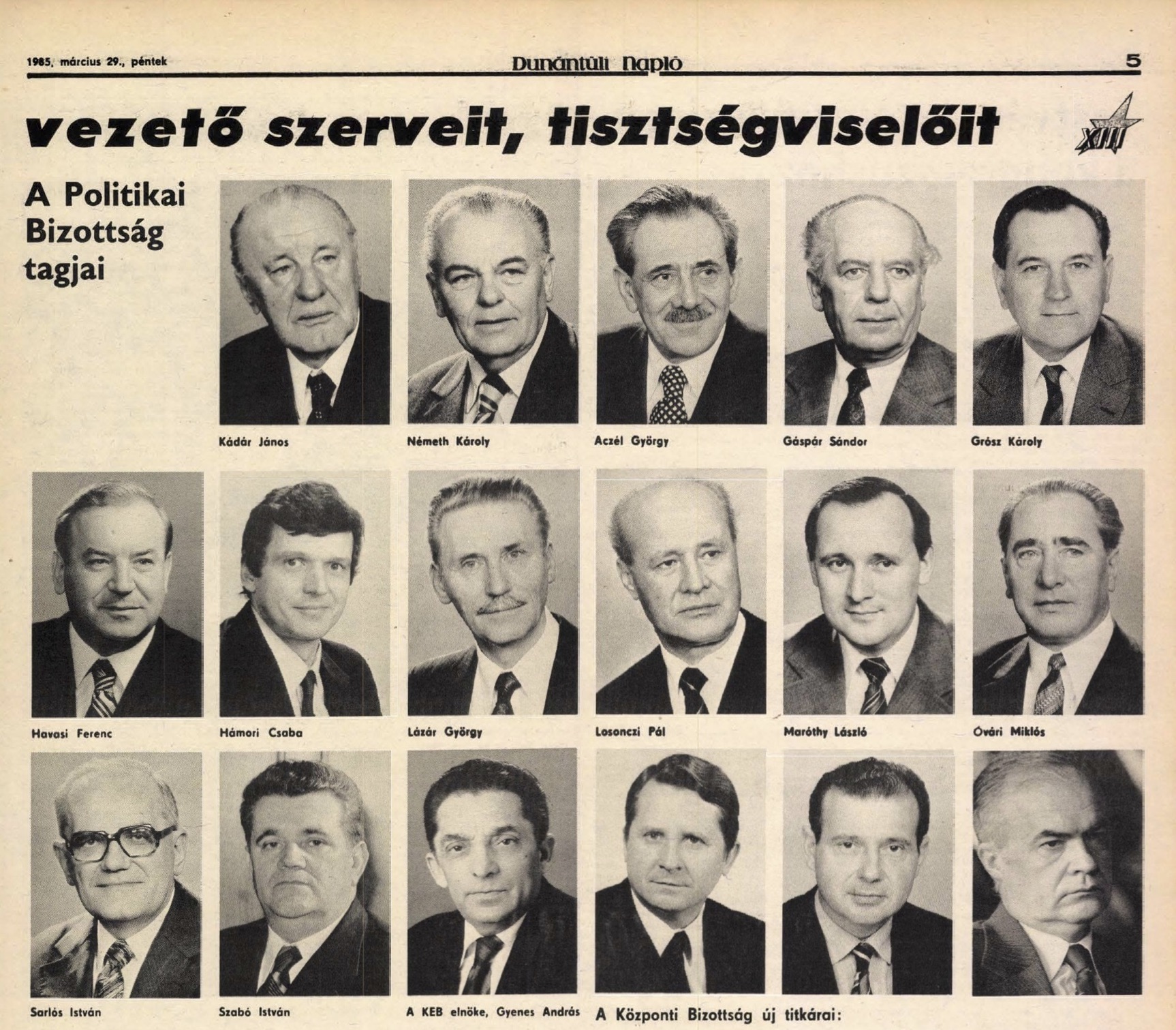
Dunántúli Napló, 29 March 1985
From the appointers’ point of view, the cadre system meant that various organisational positions were assigned to given offices of the party organisation. Members of the party-state holding certain offices were the appointers. But who were the appointees? The answer has two parts. One question is which organisations belonged to the nomenklatura system; the other is when and which positions within given organisations were brought under the party’s cadre authority. The answer to the first question is that, especially at the beginning, practically every organisation appeared somewhere on the lists. Over time more and more organisations were “let go”, but whatever was important to the party was “held” at some level through the lists. Organisations on the lists differed in how many of their positions were placed on the list of some party organ. Deeply hierarchical organisations (economically and politically important in this capacity) had several positions under party authority, while the party took only the leading positions of flatter, less significant organisations into its own hands. There was the party hierarchy, whose members functioned as the appointers, and there were the upper-level positions of politically and economically important organisations, which made up the set of appointees.
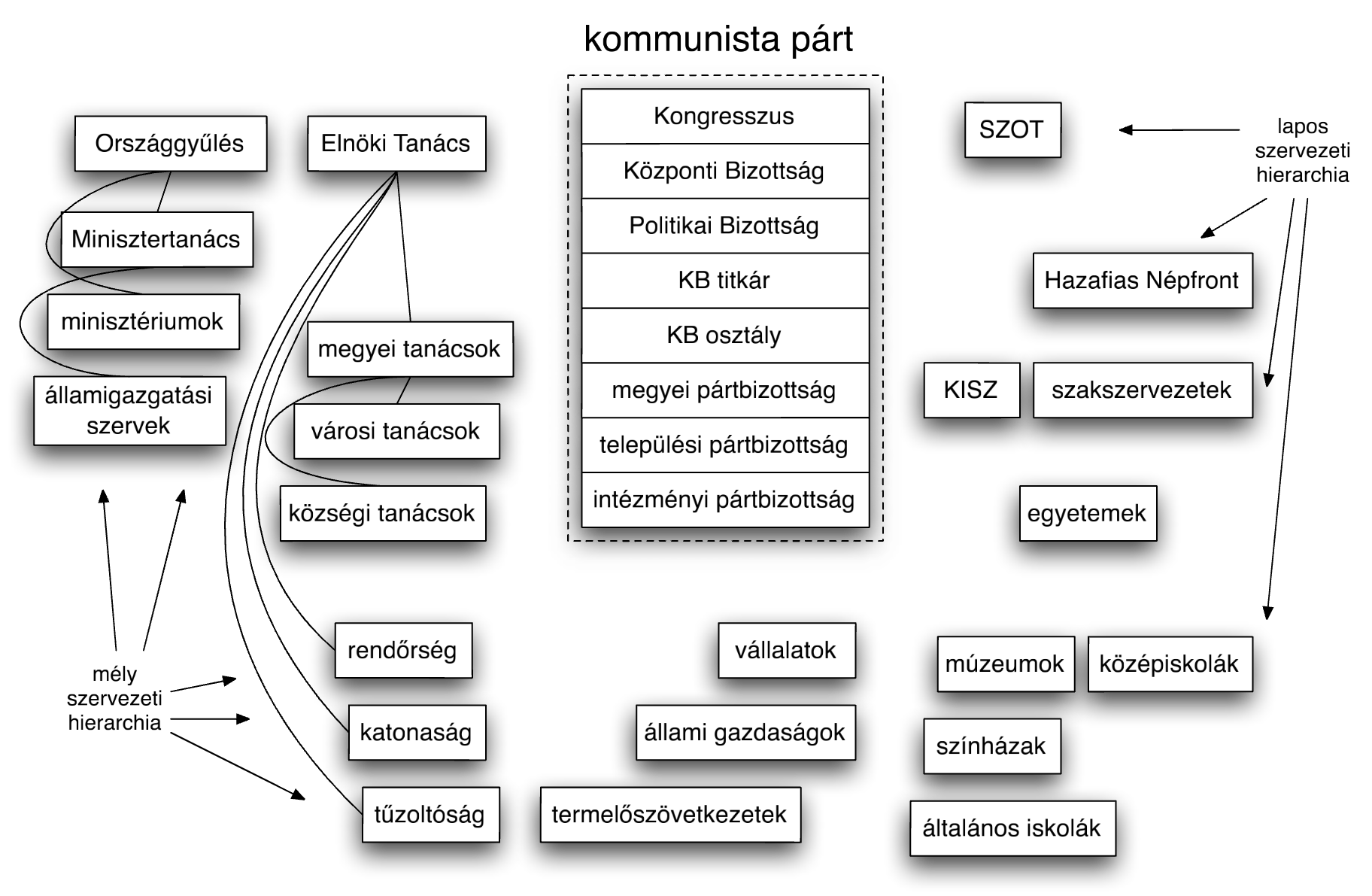
appointing and appointed organisations
Before the nomenklatura system was introduced (and after it was abolished), some of the organisations on the appointee side were autonomous and autocephalous, that is, people did not enter their leading positions from outside. There were, and are, also organisations whose top positions could be entered from outside through some mechanism of election or appointment (for example, the members of the government are elected by parliament, and the commander of a military company is appointed by the commander of the regiment or the barracks, and so on). There were, and are, heterocephalous organisations.
The cadre authority of the party-state meant that appointment questions concerning the organisations and positions drawn into the system were decided at the given level of the party. These party powers of appointment existed in parallel with the state powers laid down in formal legislation. The order of appointment prescribed by formal legislation was formally maintained throughout, but the actual decisions were made within the party.
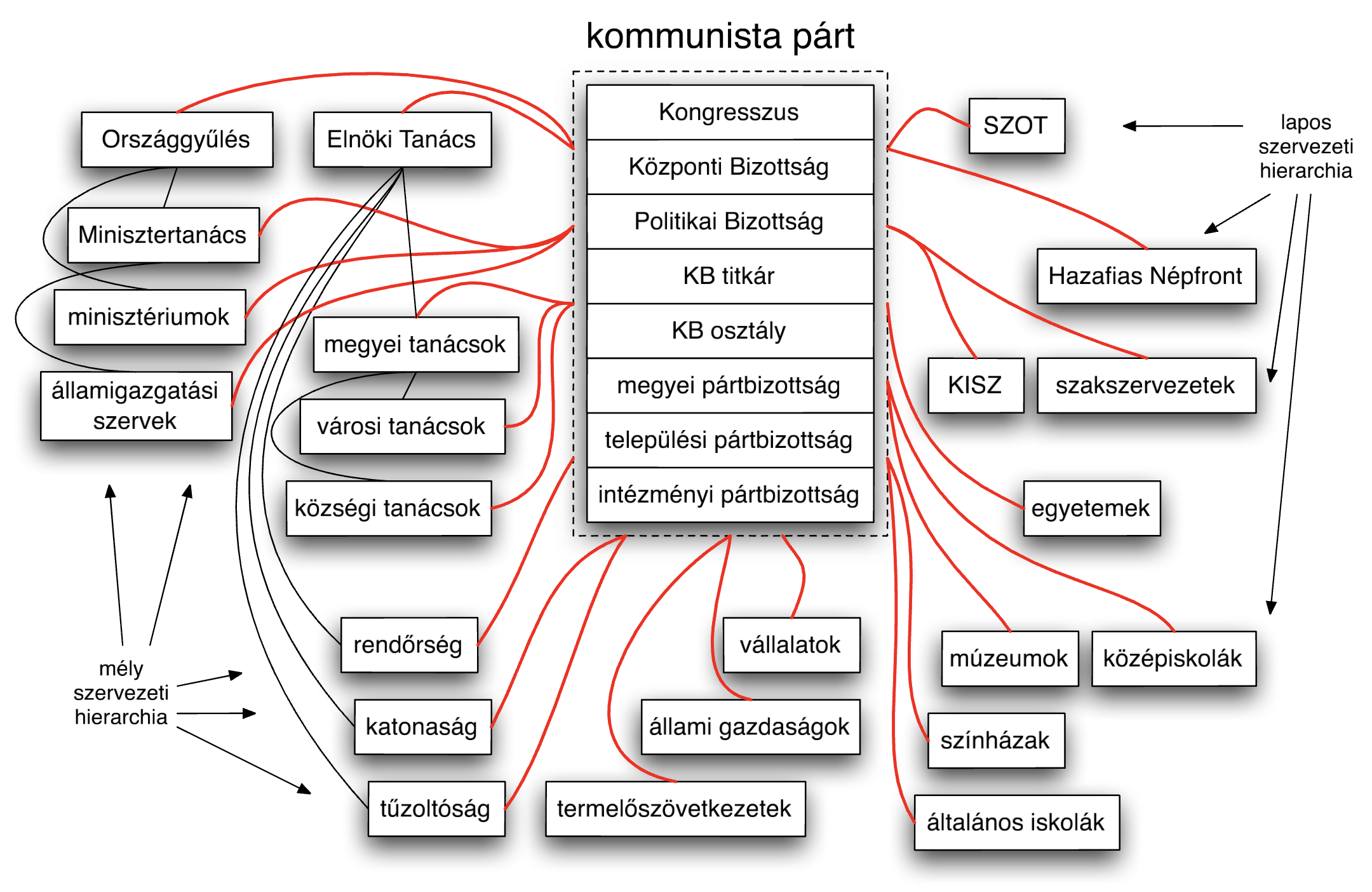
cadre authority and the formal order of appointment together
Cadre authority served to secure the party’s total influence over political, economic and cultural organisations, but the introduction of the system had unexpected (and unplanned) consequences. Perhaps the most important was that the discipline of organisations operating with a strong hierarchy weakened considerably. Let us see what exercising the nomenklatura right meant from the point of view of, say, a ministry.
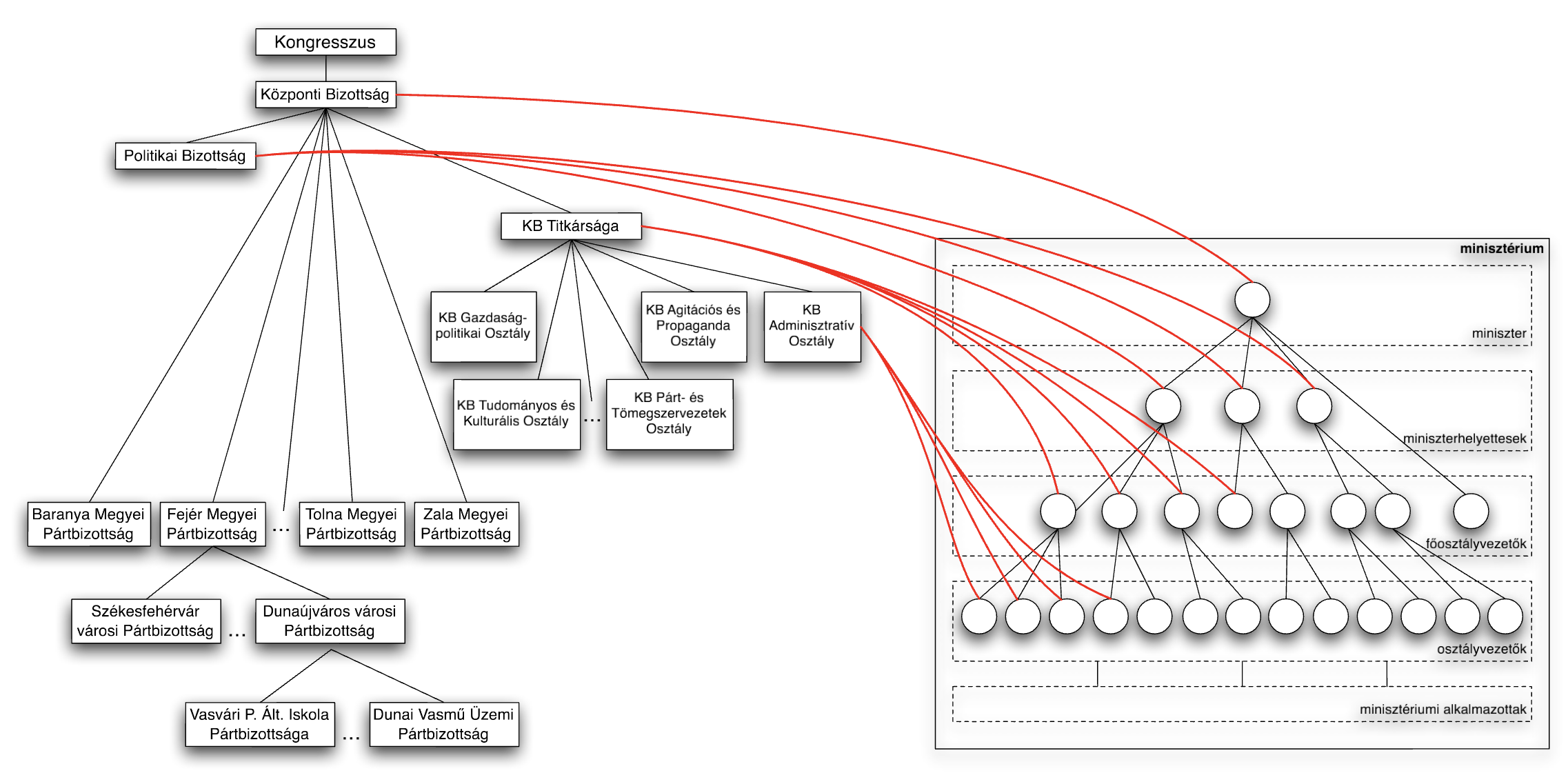
the emergence of parallel relations of authority through the exercise of cadre authority
Hierarchical organisations always have an internal order of organisation, operation and appointment, which creates clear relations of instruction and compliance within the organisation. By contrast, the exercise of cadre authority meant that the members of the organisation faced a second demand for obedience and compliance, and these two kinds of authority to instruct naturally came into “conflict” with each other. The result was that organisations became undisciplined, since the hierarchical clarity that ensured discipline had disappeared.
Changes in the nomenklatura system
The building of the nomenklatura system began as early as 1948, but it was fully built when the Communist Party had established the system of total dictatorship. In essence the system did not change until the party gave up its cadre authority in 1989.